Achilles Tendinopathy: Why Rest Alone Does Not Fix It
Risk factors, how the diagnosis is made clinically, what imaging adds, and the exercise-based treatment that works — based on the 2021 Dutch multidisciplinary guideline on Achilles tendinopathy.
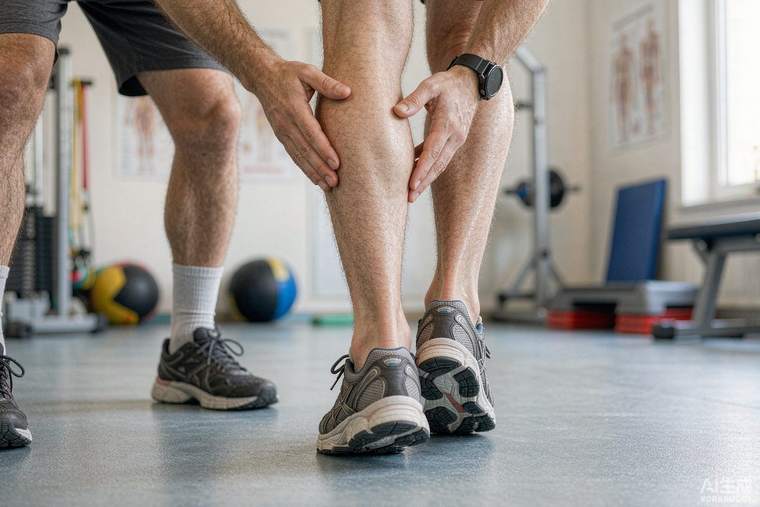
Achilles tendinopathy is a painful, overloaded Achilles tendon — most often in runners and middle-aged active people. The name matters: it is tendinopathy, a failed healing response with disorganised tendon tissue, not "tendinitis", an active inflammation. That distinction explains why complete rest and anti-inflammatory medication produce disappointing results and why progressive loading — the right amount of mechanical load, applied consistently — is the treatment with the strongest evidence. The 2021 Dutch multidisciplinary guideline covers risk factors, prevention, diagnosis, imaging, treatment and prognosis.
How it presents
Pain and stiffness along the tendon, typically 2–6 cm above its insertion into the heel, worst in the morning and after sitting, easing as the tendon warms up and returning after activity or the next day. The tendon may be thickened and locally tender. Insertional tendinopathy, at the attachment to the heel bone, behaves differently and is more often associated with a bony prominence and with compression against the shoe heel. Risk factors include a recent increase in training load or a return to sport after a break, running volume, calf muscle weakness and reduced tendon capacity, older age, previous tendon problems, and medications associated with tendon problems — fluoroquinolone antibiotics and, in some studies, systemic corticosteroids.
Diagnosis and the role of imaging
Diagnosis is clinical: localised tendon pain on palpation and with loading, reproduced by hopping or heel raises, with a characteristic history. The guideline does not recommend routine imaging for typical presentations, but ultrasound or MRI is useful when the diagnosis is uncertain, when symptoms are atypical or persistent, when a partial tear or insertional bony problem is suspected, or before invasive treatment. Imaging findings correlate imperfectly with symptoms — degenerative change is common in pain-free tendons — so an abnormal scan does not by itself explain pain, and treatment is guided by symptoms and function rather than by the image.
Treatment: load, progressed
The core of treatment is a structured loading programme. Evidence favours progressive tendon loading: isometric holds for pain relief in the irritable phase, then concentric and eccentric loading, then heavy slow resistance training, progressing to sport-specific and plyometric work as tolerance allows — typically over three to six months, with the understanding that improvement is slow and measured in months. Pain during rehabilitation is acceptable if it settles within 24 hours; a commonly used guide is to keep pain at or below about 5 out of 10 and to avoid next-morning stiffness that is worse. Relative rest means reducing the provocative load — less running, fewer hills and speed work — not immobilisation, because tendons need load to remodel.
Adjuncts and what to avoid
Corticosteroid injections into or around the Achilles tendon are generally avoided because of rupture risk. Non-steroidal anti-inflammatories give short-term pain relief but do not alter the course. Extracorporeal shockwave therapy is supported for chronic tendinopathy that has not responded to loading, and topical glyceryl trinitrate and injections such as platelet-rich plasma remain options with weaker or conflicting evidence. Night splints and heel lifts are used adjunctively, particularly for insertional disease; heel lifts reduce compression for insertional tendinopathy, while mid-portion disease responds to loading rather than lifting.
Surgery and prevention
Only a minority need surgery — after at least six months of well-performed conservative treatment — with debridement, tendon transfer or, for insertional disease, removal of the bony prominence. Prevention is straightforward: increase training volume gradually, keep calf strength work in your routine year-round, and treat early morning stiffness as a signal to adjust load rather than to push through.