Portal Hypertension and Ascites: Managing the Consequences of Cirrhosis
Why varices are screened for and how bleeding is prevented and treated, how ascites is managed with diet and diuretics, and how kidney complications are recognised — based on the 2021 Italian Association for the Study of the Liver (AISF) guideline.
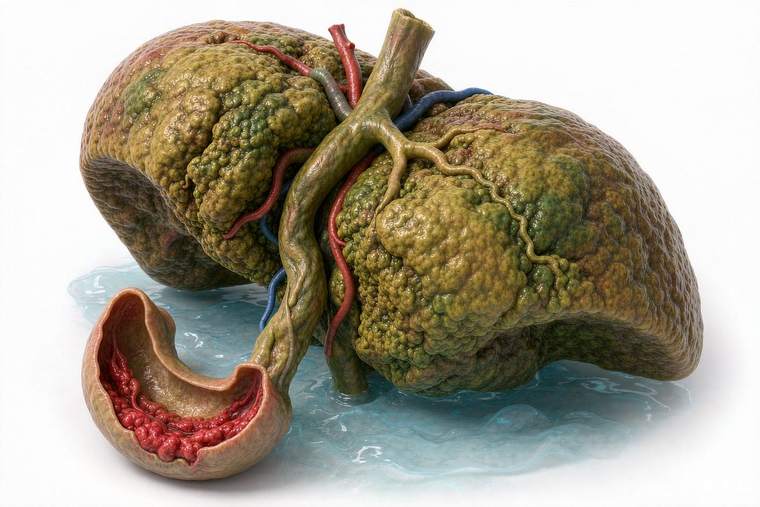
Portal hypertension and ascites mark a turning point in cirrhosis: their appearance signals a substantial change in prognosis and usually prompts referral for transplant assessment. Both are treatable, and both depend on the same underlying mechanism — raised pressure in the portal venous system caused by scarring in the liver. This guide follows the 2021 clinical practice guideline of the Italian Association for the Study of the Liver, which adapts European recommendations to everyday practice.
Portal hypertension and varices
As pressure rises, blood is diverted into thin collateral veins, which dilate into varices, most importantly at the lower oesophagus and stomach. Everyone with cirrhosis is screened with endoscopy at diagnosis and periodically afterwards; if varices are absent and the liver disease is stable, screening intervals lengthen, and small varices in patients without risk features may not require treatment. Medium or large varices, or small varices with red signs or advanced liver disease, are treated with a non-selective beta-blocker — propranolol, nadolol or carvedilol — which lowers portal pressure and reduces bleeding risk. Patients who cannot tolerate beta-blockers may have endoscopic band ligation instead.
Acute variceal bleeding
Bleeding from varices is a medical emergency with high mortality. Management combines: prompt resuscitation with careful fluid and blood replacement — not over-transfusion, which raises portal pressure and re-bleeds; vasoactive drugs (terlipressin, octreotide or somatostatin) started as soon as bleeding is suspected and continued for several days; antibiotic prophylaxis, which reduces infection and mortality and is standard; and urgent endoscopy with band ligation. If bleeding persists, a transjugular intrahepatic portosystemic shunt (TIPS) or balloon tamponade bridges the patient. After recovery, secondary prevention combines beta-blockers with scheduled band ligation until varices are eradicated, and TIPS is considered for patients who re-bleed despite this.
Ascites
Ascites is free fluid in the abdomen and is graded from mild, detectable only on ultrasound, to tense and disabling. Initial management is sodium restriction and diuretics — spironolactone alone or with furosemide, titrated with monitoring of weight, electrolytes and kidney function. Large-volume paracentesis gives immediate relief and, when more than about five litres is removed, should be accompanied by albumin infusion to prevent circulatory dysfunction. Refractory ascites is treated with repeated paracentesis, TIPS in selected patients, or evaluation for transplantation.
The kidney complication
The most dangerous development is deterioration of kidney function — most often from over-diuresis, infection or bleeding, and specifically spontaneous bacterial peritonitis, which is diagnosed by a neutrophil count in ascitic fluid obtained by tapping any patient with cirrhosis admitted with ascites. Hepatorenal syndrome is a form of functional kidney failure caused by extreme circulatory changes in cirrhosis; it is treated with vasoconstrictors plus albumin and requires urgent specialist care. The practical rule: any sudden rise in creatinine in cirrhosis needs immediate assessment, and nephrotoxic drugs — particularly NSAIDs and aminoglycosides — should be avoided.
Practical guidance
Weigh yourself daily, keep to a low-sodium diet without severe fluid restriction unless sodium is very low, avoid alcohol completely, and never take NSAIDs. Keep up to date with vaccinations for hepatitis A and B, influenza, pneumococcus and COVID-19. Ask about transplant assessment as soon as ascites or variceal bleeding appears — referral should precede, not follow, the emergency.