In short
The 2025 Chinese interventional ultrasound guideline defines equipment standards, aseptic technique, path planning rules, and the biopsy technique — fine-needle or core — that gives the best diagnostic yield by organ.
What this guide covers: Equipment and needles · Aseptic technique · Planning the path · Biopsy technique and yield · Organ-specific notes
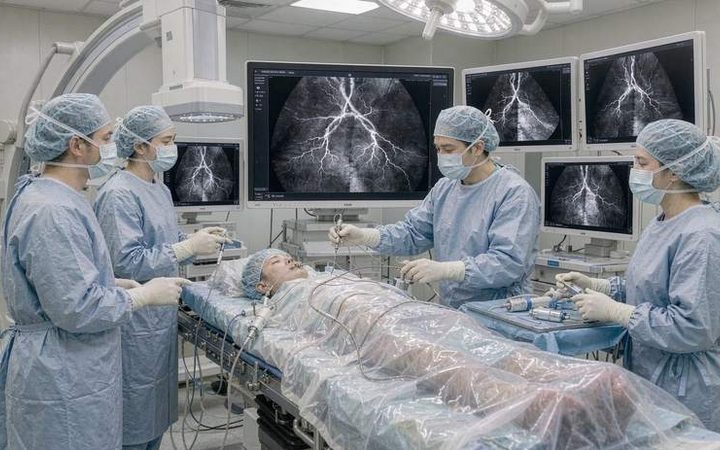
Interventional ultrasound covers everything done with a needle or probe under real-time ultrasound guidance: biopsy, drainage, tumour ablation, nerve block and vascular access. It has grown rapidly because it is accurate, radiation-free and can be done at the bedside. The 2025 Chinese guideline on interventional ultrasound — a revision of the 2018 edition, produced jointly by the Chinese Medical Association and Chinese Medical Doctor Association ultrasound societies using GRADE — sets the standards for how it should be performed.
Equipment and needles
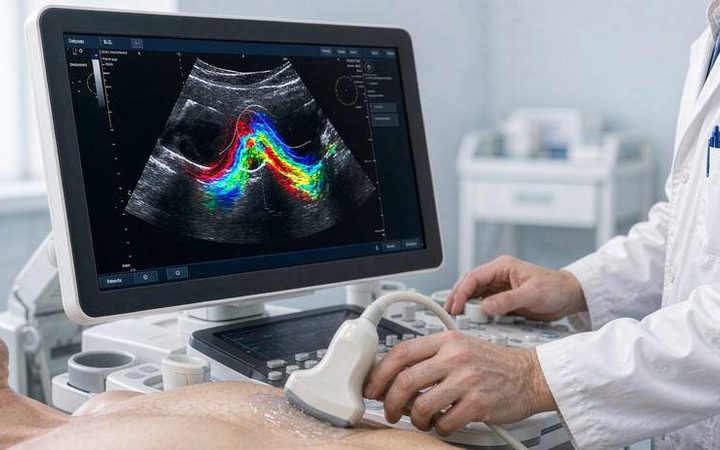
The guideline specifies what a unit needs: a high-resolution colour Doppler machine with convex, linear, endocavitary and phased-array probes covering the relevant frequency ranges, and imaging modes including colour and power Doppler, elastography and contrast-enhanced ultrasound. Needle-guide software with an adjustable angle and, increasingly, fusion imaging with CT or MRI are part of modern practice.
Needle choice follows the task. Fine-needle aspiration uses 21 to 25 gauge needles for cytology and cyst fluid. Core needle biopsy uses 14 to 18 gauge cutting needles when tissue architecture or molecular testing is required. Drainage catheters run 8 to 16 French. Ablation probes and nerve-block needles have their own specifications.
Aseptic technique
Sterility is treated as non-negotiable. The room is disinfected, surfaces are cleaned, skin is prepared with chlorhexidine-alcohol or povidone-iodine over a field of at least 15 cm, and the probe is either covered with a sterile sheath or high-level disinfected — wiping with alcohol alone is explicitly inadequate. Sterile probe covers and single-use guide brackets with an angular error of no more than one degree are recommended.
Planning the path
Three rules govern the needle track. Choose the shortest safe route. Avoid vessels over 3 mm, bile ducts, the pancreatic duct and bowel, and keep to normal tissue at least 5 mm from the lesion edge as the entry corridor. Keep the entire path and the needle tip visible throughout, using a combination of in-plane and out-of-plane approaches.
Anaesthesia is usually local infiltration with lidocaine, with a defined maximum dose. Where sedation is used, monitoring of heart rate, blood pressure and oxygen saturation, intravenous access and resuscitation equipment are required, and higher-risk patients are managed with anaesthesia support.
Biopsy technique and yield
Fine-needle aspiration uses a 10 ml syringe with 5 to 8 ml of negative pressure and three to five passes, with the sample immediately smeared and fixed. Adequacy is defined in the guideline — at least two satisfactory specimens — and sensitivity is typically 75 to 90 percent with specificity near 100 percent.
Core needle biopsy obtains two to four cores of at least 10 mm, and the guideline states that its diagnostic accuracy of roughly 90 to 98 percent is significantly better than FNA, which is why core biopsy is preferred whenever histology, grading or molecular markers are needed.
Organ-specific notes
For liver biopsy the approach is percutaneous, avoiding large intrahepatic vessels and staying at least 1 cm below the capsule, with observation for two to four hours afterwards because bleeding occurs in 0.5 to 2 percent of cases. For thyroid, the threshold is TI-RADS 4 or above, with size cut-offs differing between 4A and 4B/4C, sampled with a 25 gauge needle from multiple angles.
Contraindications
Absolute contraindications to biopsy are severe coagulopathy — platelets below 50 x 10^9/L, INR above 1.5, or APTT beyond 60 seconds — uncontrolled infection, and inability to cooperate. Relative contraindications such as a lesion adjacent to a major vessel, organ failure or massive ascites require a multidisciplinary decision.
Why the standards matter
Most complications of interventional ultrasound are predictable and preventable. When a unit follows a written protocol for sterility, path planning and post-procedure observation, serious adverse events are rare — and that is the practical purpose of this guideline.
Sources and further reading
One reference to a U.S. government health source (National Institutes of Health or MedlinePlus) for the medical background of this guide. It is context, not a substitute for advice from your treating doctor.
General information for international patients, not medical advice or a diagnosis. Read the medical disclaimer.